Focused on JSM-linked Confluence content, not arbitrary Confluence-wide crawling.
 ResolveLoop
KB Sentinel for Jira Service Management
Fix the knowledge defects behind bad support answers.
KB Sentinel is a Forge app for Jira Service Management Cloud plus Confluence Cloud. It continuously checks JSM-linked Confluence content for drift, contradictions, duplication, missing coverage, and weak structure so teams know what to fix first.
Persisted tenant state stays in Forge-hosted storage as derived excerpts, findings, drafts, and score history.
External model egress is limited to repair drafting when OpenAI-backed drafting is configured.
Why the product exists
Bad self-service answers usually start upstream.
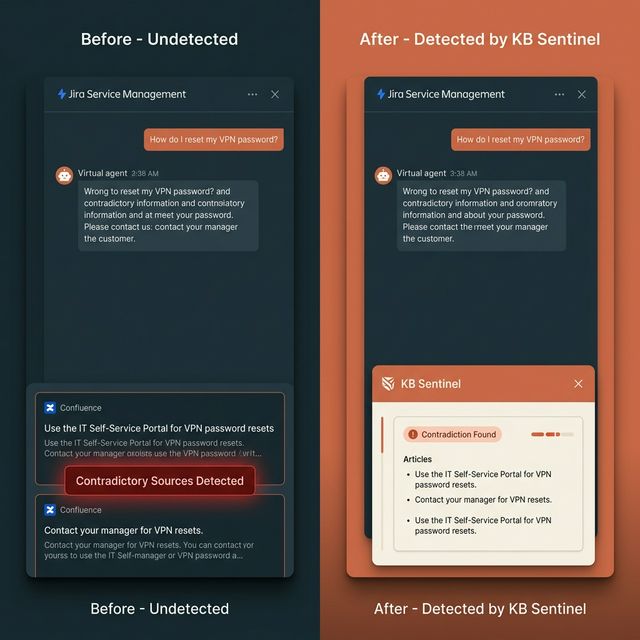
When linked knowledge articles drift or contradict each other, virtual-agent answers and support handoffs inherit the same problem.
Contradictions hide inside normal KB maintenance.
Teams update one article, another article lags behind, and the broken answer path only shows up later as repeat support friction.
KB Sentinel inspects the source material, not the chat veneer.
The product surfaces evidence, ranks what matters, drafts a repair path, and helps operators keep high-value intents under repeatable QA.
What the app actually does
Continuous KB QA tied to support outcomes.
KB Sentinel is not another chat surface. It finds content defects, ranks what matters by real support demand, and helps teams repair and verify the source material.
The operational loop
Find the defect. Understand the support risk. Repair it with evidence. Verify it does not drift back.
Detect drift, contradictions, duplication, and missing coverage.
The app continuously checks the knowledge assets already linked to Jira Service Management so stale or conflicting content stops hiding in plain sight.
Prioritize defects by the support intents that already matter.
Instead of generic stale-page reporting, KB Sentinel ties findings back to demand signals so operators can fix the highest consequence issues first.
Review a repair draft, preserve the history, and keep a regression suite.
Human approval remains explicit. The product keeps evidence, repair context, and repeatable checks so improvements survive the next content update.
Inside the app
Built for operators who need a fix-forward path.
The dashboard is shaped around the next useful decision: which article is risky, why it matters, and what a repair path should look like.
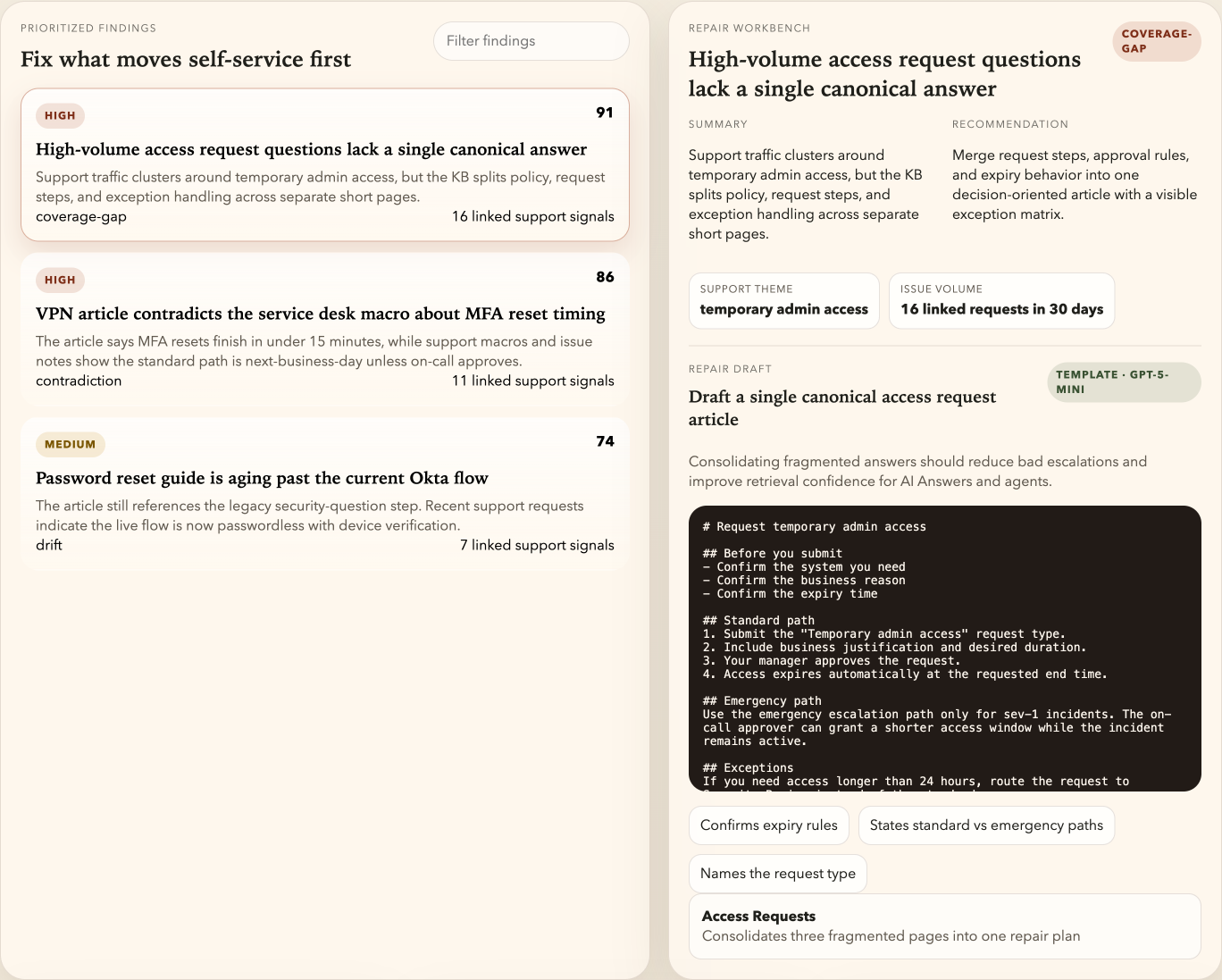
Repair workbench
Prioritized findings, evidence, and repair context in one working view.
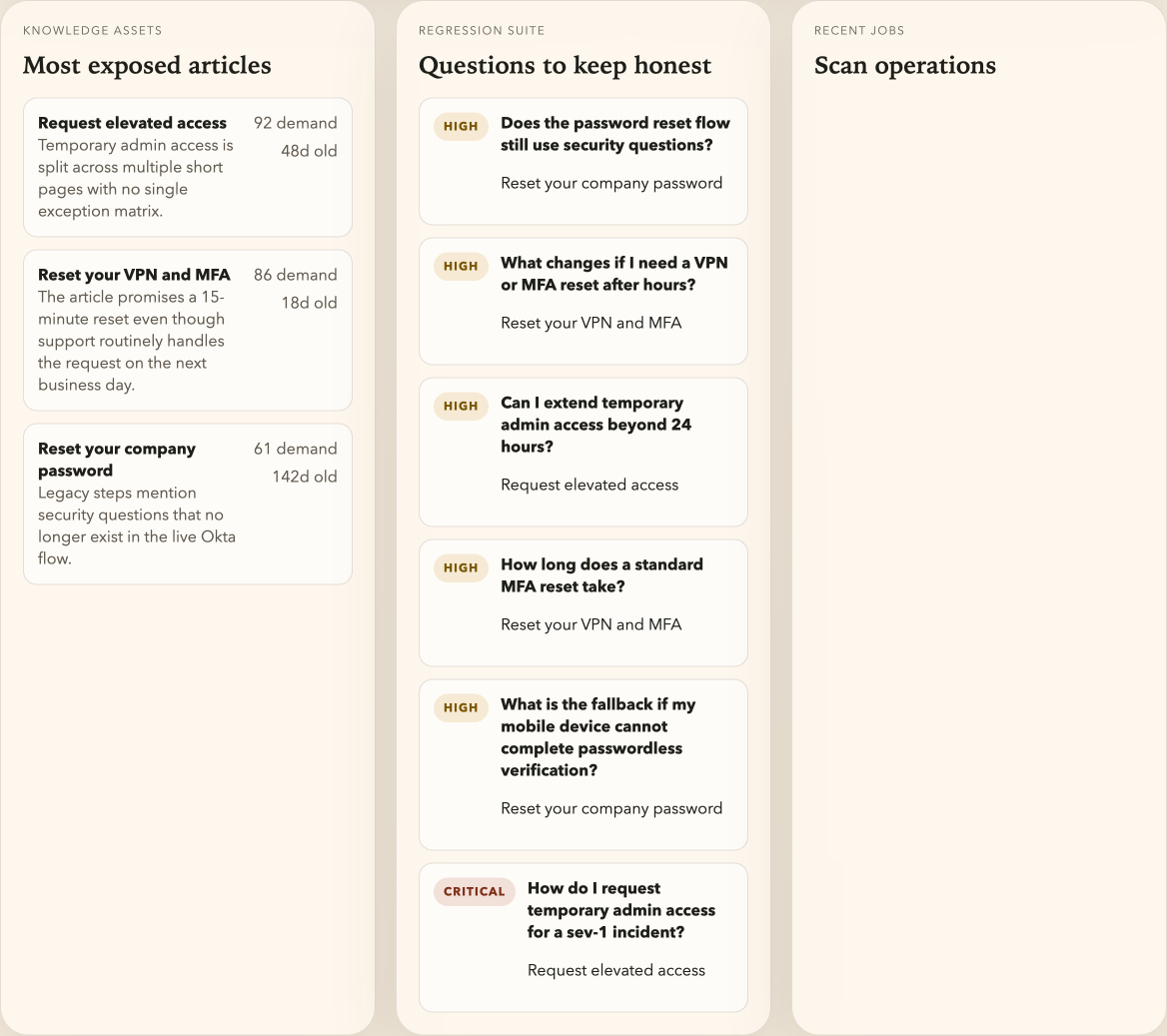
Knowledge assets and regression view
Recent scans, exposed content, and repeatable checks stay visible together.
Single-lane pilot
Start narrow enough to learn something real.
The launch motion is operational on purpose: one support lane, one linked knowledge source, and one outcome you can measure on a small set of high-volume intents.
Choose the lane that already causes repeat friction.
VPN access, payroll corrections, office access, and other high-volume request clusters make strong pilot candidates because the answer quality problem is already visible.
Scan the JSM-linked Confluence content in that lane.
KB Sentinel inspects the linked article set for drift, contradictions, duplication, coverage gaps, and weak structure, then ranks what to fix first.
Review findings, repair drafts, and regression checks.
The pilot should leave the team with a usable repair queue, a clearer answer path, and a small regression suite to keep the lane honest after updates.
Pilot lane ideas
Start with a support story leadership already recognizes.
These launch lanes map cleanly to repeat demand, clear answer paths, and visible defects.
Identity and access
MFA, VPN, temporary admin access, and password reset guidance are frequent sources of conflicting instructions and brittle answers.
Employee help flows
Onboarding, leave, payroll, and policy content often drifts across teams even when each article looks acceptable in isolation.
Office operations
Badge access, visitor handling, and facilities support are strong pilots when operations change faster than the knowledge base keeps up.
Trust and diligence
Public launch posture, without the overclaim.
Forge-hosted persisted state with limited OpenAI egress for repair drafting. The rest of the diligence story lives in the public trust documents below.
What we can say today
Persisted state
Tenant state is stored in Atlassian Forge-hosted storage rather than a separate external customer database at launch.
Retained content
The product is designed to keep reduced excerpts, findings, repair drafts, scan history, and score trends instead of full raw KB mirrors.
Model processing
If drafting is enabled, selected excerpts and finding context may be sent to OpenAI to generate repair drafts.
Trust boundary
The launch posture is explicit about egress and does not claim Runs on Atlassian.
Security
Open
Architecture summary, disclosure path, and current subprocessor posture.
Privacy
Open
Handled data categories, storage model, retention posture, and repair-drafting egress summary.
DPA
Open
Launch-stage data processing terms for buyer review and pilot diligence.
Terms
Open
Current commercial boundaries for pilot customers and launch review.
Subprocessors
Open
The launch provider footprint and how it will be updated if the stack changes.
Support
Open
Launch support model, response targets, and escalation contacts for pilot customers.
Start here
Request your pilot walkthrough.
The fastest first conversation is still operational: one support lane, one linked knowledge source, and one answer-quality problem worth fixing.
Or email directly: ahmad@getresolveloop.com